


What do Pt, Pd and Rh have in common? They are the chemical symbols for platinum, palladium and rhodium, and all are found inside every catalytic converter on the road today. Being extremely rare and difficult to mine, these metals can routinely command prices higher than gold on the precious metals market, making catalytic converters a prime target for theft. In 2022 alone, the price of palladium spiked from $1,000 to $3,000 per ounce. Long-term palladium price forecasts for 2036 differ drastically, but some experts predict it could reach as high as $5,500 per ounce.
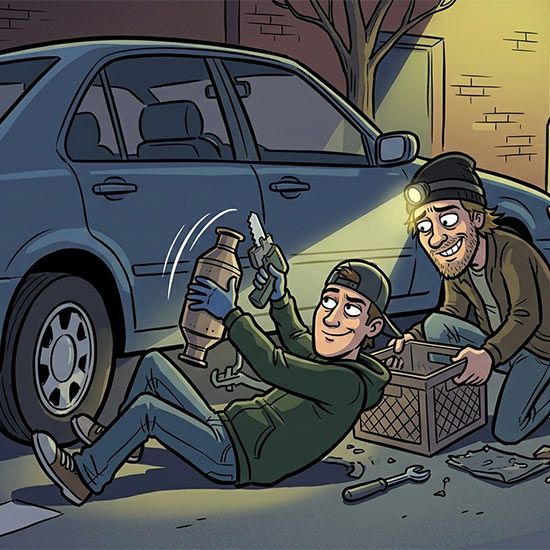
Knowing that OEM converters on new car lots contain nearly 10 times more precious metal content than aftermarket converters makes them a more attractive target for thieves. In as little as 15 seconds, a new car’s catalytic converter can be removed, enabling thieves to quickly move from car to car, increasing their take for the night, often without being captured by security cameras. Dealers who have been victimized say it’s not just the cost of the catalytic converter; the collateral damage to the car during removal adds dramatically to the vehicle’s restoration costs.
Catalytic converter theft was originally considered to be a problem only for urban dealers. However, police reports confirm that such theft is radiating out into the more trusting auto dealer markets. Growth in hybrid and full ICE vehicles will keep catalytic converter availability high now that the full EV push has subsided.
Efforts to strengthen federal and state legislation requiring authorized recyclers to obtain greater sales transaction documentation and identification of legitimate sellers of catalytic converters, such as scrap yards, only make these authorized recyclers and sellers more legitimate. It does nothing to suppress a black market that invariably surfaces when such valuable and untraceable materials are involved. Once the exterior housing of a converter has been removed, there is no identity as to its origin (i.e., the car from which it was stolen), and its metals become as untraceable as gold jewelry that is melted into an ingot and sold on the spot market. Thieves know this and they will always find a “fence” who will pay cash for the stolen converters, no questions asked.
At Trydon®, we believe that the most common-sense way to protect your dealerships from criminals is by keeping them from entering your site in the first place. You have a network of light poles strategically placed throughout your site, and specifically along your perimeter, so why not empower them to act as nighttime sentries capable of detecting and responding when someone first enters your lot? That is precisely what ChaseLight™ does.
ChaseLight’s technology understands the difference between the behavior of criminals and the interests of car shoppers. BrowseHours™ welcomes car shoppers for an early after-hours walk-through of your vehicle inventory, after which ChaseLight’s motion-sensing ability dramatically deters unwanted trespassers from remaining on your site. And it pays for itself by enabling you to dim your LED lights in a highly coordinated fashion, reducing your after-hours energy costs by as much as 90% without compromising safety or merchandising impact.
With 100% deductibility of capital improvements now allowed in the first year of operation, combined with Trydon’s subscription program, you can preserve your cash for more important matters, such as purchasing cars for resale rather than tying it up in bricks and mortar.
Additional benefits of the Trydon subscription program:
- 100% warranty support (parts and labor) for all equipment (lighting controllers, new lights, even light poles) supplied to the project
- All Trydon software upgrades and enhancements are installed by Trydon personnel
- 24-hour telephone-based customer support
Making Trydon the first capital project of the year can support additional site improvements later on. We welcome the opportunity to show you how we can benefit your operation. To learn more, please visit chaselight-tech.com.